
Tottenham's Relegation Crisis Deepens as West Ham Secure a Vital Win
Authored by slotshop.info, 15-04-2026
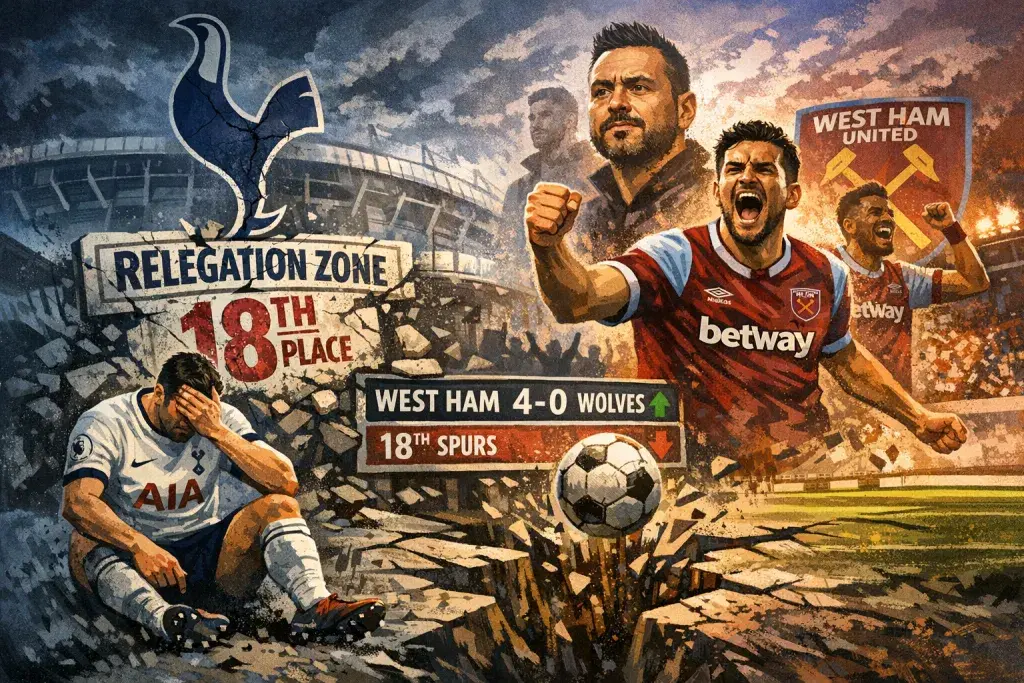
For the first time in 17 years, Tottenham Hotspur find themselves occupying a relegation position in English football's top division — a development that would have seemed almost inconceivable just twelve months ago, when the club was celebrating European success. West Ham's emphatic 4-0 victory over Wolverhampton Wanderers on Friday pushed Spurs down into 18th place, crystallising what has been a prolonged institutional collapse rather than a sudden misfortune.
A Fall From Grace With Deep Structural Roots
The last time Tottenham sat this low in the English football pyramid was January 2009, under Harry Redknapp, following a defeat to Wigan Athletic. That episode proved temporary. The danger now feels considerably more entrenched. Spurs have failed to secure a victory in any of their last 13 top-flight fixtures. Eight of those ended in defeat. The club has not won a home fixture since early December. These are not the statistics of a side experiencing a rough patch — they are the hallmarks of a club in structural distress.
What makes the situation so remarkable is the speed of the decline. European football in one calendar year, the threat of second-tier football the next. The causes are rarely simple in these cases, but the pattern is recognisable: managerial instability compounding squad uncertainty, with each failed appointment narrowing the window for recovery. Thomas Frank and Igor Tudor have already departed the role this season. Roberto De Zerbi now becomes the third individual tasked with halting the slide, with just seven fixtures remaining in the 2025-26 campaign.
De Zerbi Inherits the Most Pressurised Situation of His Career
De Zerbi's appointment carries significant weight given his reputation for building cohesive, possession-oriented sides — most notably during his time at Brighton. But reputation means little when the fixture list is unforgiving and squad confidence has been visibly eroded over months of poor results. His first fixture is away at Sunderland, followed by encounters against Brighton and Wolves before a punishing final month that includes Aston Villa, Chelsea, and a potentially decisive final-day clash against Everton.
Managerial changes at the bottom of the table are a well-documented gamble. Research into mid-season appointments consistently shows that while a new appointment can generate short-term improvement — often attributed to a psychological reset within the playing group — the effect tends to be temporary unless accompanied by clarity of system and personnel. De Zerbi has fewer than two weeks to implement either before his first significant test. The margin for error is functionally zero.
West Ham's Revival and the Dynamics of the Relegation Battle
Friday's result was not simply a local rivalry outcome — it reconfigured the entire lower end of the division. West Ham, now under Nuno Espírito Santo following Graham Potter's earlier departure, moved to 17th position and two points clear of the danger zone. Konstantinos Mavropanos and Taty Castellanos each contributed a brace, and the four-goal winning margin carried additional significance: in a tightly contested relegation battle, goal difference can ultimately determine survival as decisively as points.
West Ham's remaining schedule is demanding. Three London derby fixtures and a home encounter against Arsenal represent a formidable run-in. But there is a psychological distinction between facing pressure from a position of relative control and facing it from within the bottom three. The Hammers now hold their fate in their own hands in a way Tottenham simply do not.
What Relegation Would Actually Mean for Tottenham
The financial and reputational consequences of relegation for a club of Tottenham's scale are severe and, in some respects, long-lasting. Revenue from broadcasting rights drops substantially in the second tier of English football. Commercial partnerships frequently contain top-flight clauses. Perhaps most critically, the club's ability to retain and attract the quality of personnel required for an immediate return becomes significantly compromised — a dynamic that has trapped more than one historically significant English club in a prolonged cycle of decline.
Tottenham's position is a cautionary study in how quickly elite status can become precarious when institutional decision-making falters. The club invested heavily in infrastructure over the past decade — their stadium is among the most impressive in European football — yet infrastructure alone cannot substitute for coherent sporting leadership. With seven fixtures standing between the club and either survival or a seismic fall, every decision made in the coming weeks carries consequences that will define Tottenham's trajectory for years.